
The math on housing stopped working, and nobody rewarded you for noticing
There's a number that explains most of the anxiety around housing in America right now, and it isn't the mortgage rate.
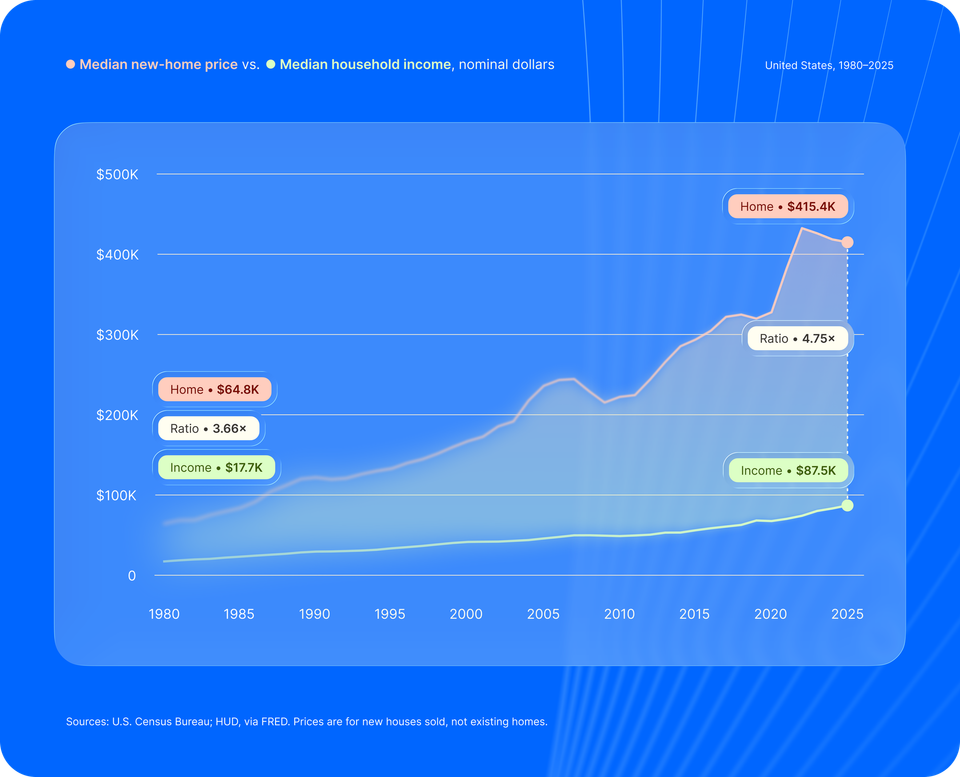
It's the ratio between what a home costs and what a household earns. In 1980, the median home cost about 3.66 times the median household income. Today it's 4.75, down from a 5.81 peak in 2022 but still nearly double the 2.6 ratio financial experts generally consider affordable. As of early 2026, every metro among the 50 largest in the country now sits above that threshold. Not most. All of them.
What the gap actually looks like
The median U.S. home now costs around $415,400. The median household earns about $87,460 a year. Home prices have risen 30% since 2019 alone, while median household income has climbed only 27% over the same stretch. The gap didn't close. The gap has eased since its 2022 peak, but it's still higher than in all but a handful of years since 1980.
Put a mortgage payment next to a paycheck and the strain is even clearer. A family earning the national median income needs roughly 32% of that income just to cover the mortgage payment on a median-priced new home, according to the NAHB/Wells Fargo Cost of Housing Index for the first quarter of 2026. A low-income family, defined as earning half the median, would need 65% of their income to make the same payment. At the current median new home price, an estimated 65% of U.S. households can't afford to buy one at all.
Renting isn't the escape valve it used to be
For households who've given up on buying and are renting instead, the numbers aren't much kinder. Nearly half of the nation's 42.5 million renter households, 49.7%, spend more than 30% of their income on housing, the federal government's own definition of cost-burdened. Among renters earning under $30,000 a year, that number climbs to 83%, with the majority of that group severely cost-burdened, spending more than half their income on rent alone.
This isn't a story about people making poor decisions. It's a structural gap between what housing costs and what households bring in, and it shows up whether you're trying to buy or trying to rent.
Who gets locked out first
The clearest evidence of the squeeze is who's disappearing from the buyer pool entirely. First-time homebuyers made up 44% of the market in 1981. By 2025, that share had fallen to 21%. The median age of a first-time buyer has climbed in step, from 29 in 1981 to 40 today. An entire decade of adult life, the decade many people used to spend building equity, has been pushed out of reach for the typical first-time buyer.
Existing home prices are up 54% nationwide since 2020 and now sit at nearly 5 times median incomes, well above the ratio of roughly 3 that held through the 1990s, according to Harvard's Joint Center for Housing Studies. The math didn't drift. It broke.
Why this belongs in the conversation about rewards
Rent and mortgage payments are the single largest recurring expense most households carry, and they're also two of the only major expenses that virtually no rewards program touches. You can earn 3 to 4% cash back on dinner. You can earn 5x points on a flight. Try to find a mainstream card that rewards the payment that actually determines whether you can afford to live where you live, and the options thin out fast.
That's not a coincidence. It's a byproduct of how card rewards get funded, and it's part of why Fold built bill pay rewards into Fold Reserve, up to 3% back in bitcoin on rent and mortgage payments made via ACH. The 3% rate requires a $100,000 Fold Reserve balance and applies to your first $5,000 in bill payments each month. Bill payments above that earn nothing. Bill pay rewards start at 0.25% with a $5,000 Reserve balance.
It's a small offset against a very large number, not a fix for the underlying affordability gap. Nothing offsets a 4.75 price-to-income ratio. But being one of the only places that rewards the payment at all felt worth building.
The housing math isn't going to fix itself anytime soon. Whatever helps, even a little, is worth having in the mix.
Sources
- U.S. Census Bureau, Income in the United States: 2025
- U.S. Census Bureau and HUD, Median Sales Price of Houses Sold
- Best Interest Financial, Home Price-to-Income Ratio Analysis, February 2026
- National Association of Home Builders, Housing Affordability Edges Up in First Quarter but Challenges Persist, Q1 2026
- National Association of Home Builders, Impact of Affordability Challenges and Demographic Shifts on Housing Trends in 2026
- Eye on Housing (NAHB), How Rising Costs Affect Home Affordability, February 2026
- U.S. Census Bureau, Nearly Half of Renter Households Are Cost-Burdened, Proportions Differ by Race
- Harvard Joint Center for Housing Studies, Ten Takeaways from the 2026 State of the Nation's Housing
- Harvard Joint Center for Housing Studies, Renters' Affordability Challenges Worsened Last Year
Disclosures: Fold Reserve is closed-loop stored value issued by Fold, Inc. and redeemable only for Fold products and services. It is not a bank account, deposit account, or savings account, is not redeemable for cash, and is not insured by the FDIC or SIPC. Your Reserve balance earns nothing on its own. See the Fold Terms and Conditions.
Rewards are earned on your eligible spend, not on your balance. The Fold Bitcoin Credit Card earns a 1.50% base rate on all eligible purchases with no cap and no Reserve balance required. The Fold Prepaid Debit Card (issued by Sutton Bank) earns a 0.25% base rate on all eligible purchases with no cap and no Reserve balance required. A Reserve balance of $5,000 or more is required to earn on eligible ACH bill pay, which earns 0.25%. Your rate increases above these base rates as your Reserve balance grows, starting at $15,000. Any amount above the base rate applies only to the first $5,000 of eligible spend each calendar month, counted separately for card spend and for bill pay. Card spend above that cap earns the base rate and bill pay earns nothing above it. Maximum rates at a $100,000 Reserve balance are 5.00% on the Fold Bitcoin Credit Card, 3.00% on the Fold Prepaid Debit Card, and 3.00% on bill pay. You earn a boost on only one card: if you hold the Fold Bitcoin Credit Card, the boost applies to that card and your debit card earns the base rate. Bill pay is unaffected by which card you hold. Rates are subject to change. See the Fold Terms and Conditions for details and tier requirements.
Rewards are paid in bitcoin and are unsecured promotional obligations of Fold, Inc. They are not deposits, are not FDIC or SIPC insured, are not paid by any bank, and may lose value. Rewards are earned on eligible spend, not on any balance you hold. Rewards pend for 30 days before they are credited, and are reversed in proportion to any purchase that is returned, refunded, disputed, or reversed. Your Rewards Account is limited to $10,000, and you must withdraw below that limit to keep earning. Rewards can be redeemed once your balance reaches 30,000 sats. If your Fold account becomes inactive, Fold may reduce your Rewards Account balance by 0.01 BTC per month and may close the account and forfeit the balance. Rewards may be worth more or less at redemption than when earned. Bonus categories, earning rates, tier requirements, and offer availability are subject to change and may be capped or limited in duration. See the Fold Terms and Conditions for earning exclusions and full details.