
The rewards industry is upside down
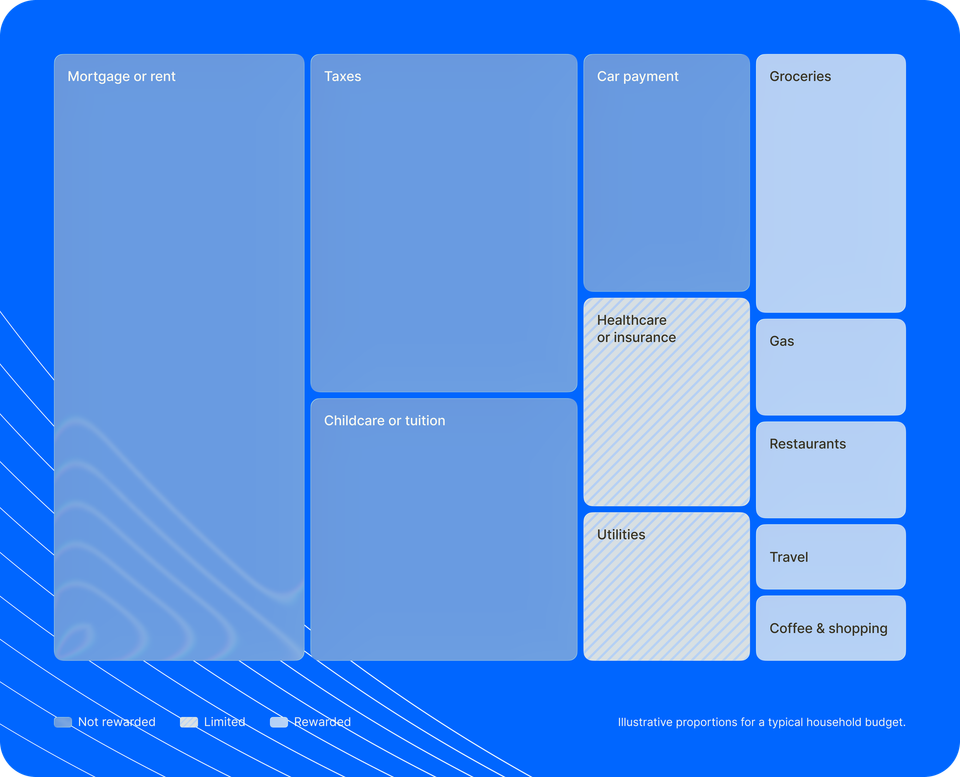
The more important an expense is to your life, the less likely you are to be rewarded for it.
That sentence sounds like it should be wrong. It isn't. Look at your own spending and you'll find the pattern almost immediately: the small, discretionary things you buy earn you the most. The large, unavoidable things you pay for earn you nothing at all.
The chart above shouldn't surprise you, but does
Line up household expenses by size and ask a simple question: is this rewarded today?
- Mortgage or rent: large, no
- Taxes: large, no
- Childcare or tuition: large, no
- Car payment: medium, no
- Healthcare or insurance: medium, limited
- Utilities: medium, limited
- Groceries: small, yes
- Gas: small, yes
- Restaurants: small, yes
- Travel: small, yes
- Coffee, entertainment, shopping: smallest, yes
Read down that list and the shape of it becomes obvious. The rewards get bigger as the expenses get smaller. Cashback rewards what you buy. It has nothing to say about the cost of living.
Why the industry built it this way
This isn't an accident or an oversight. It's an economic decision that made sense for the people who built these programs, just not for the people using them.
Card issuers make money on interchange, the small fee merchants pay every time a card is swiped. Restaurants, travel, and retail are categories with healthy margins and heavy competition for your wallet, so issuers can afford to hand back 3 to 5% and still come out ahead. A restaurant-focused card today typically tops out around 4% cash back, and the most competitive general travel cards lean into multipliers like 5x on travel and 3x on dining to win that spending. Rent, mortgage payments, and utility bills don't work that way. Landlords and mortgage servicers mostly don't accept cards directly, margins on those payments are thin to nonexistent, and issuers have little incentive to reward a transaction that doesn't generate the fee income that funds the rewards in the first place.
The result is a rewards industry built entirely around discretionary spending. Every major card on the market reflects it: bonus categories for dining, groceries, gas, and travel, and a flat, unremarkable base rate, usually 1x, for everything else. Everything else is where your rent lives. Where your mortgage lives. Where your childcare bill lives.
The expenses that actually stretch a household
It's worth sitting with how large these "everything else" expenses have become.
Housing, for most Americans, is no longer a rounding error. The national home price to income ratio now sits at roughly 5.08, nearly double the 2.6 ratio financial experts generally consider affordable, and a sharp climb from 3.65 in 1980. Nearly half of the country's renter households, 49.7%, spend more than 30% of their income on housing, the federal threshold for being considered cost-burdened. Among renters earning under $30,000 a year, that figure jumps to 83%.
Childcare tells a similar story. The federal government defines affordable childcare as no more than 7% of family income. The average American family is actually spending 20% or more, according to the 2026 Cost of Care Report from Care.com, which surveyed 3,000 parents nationally. Center-based childcare now averages roughly $13,000 to $15,000 a year per child, and for single parents, childcare alone can eat up 35% of household income, more than three times the rate for married couples.
Neither of these expenses shows up as a bonus category on a single major credit card. Both are large enough to define a household's financial life. That's the inversion in a sentence: the bigger and more unavoidable the cost, the less the rewards industry has bothered to touch it.
What this actually costs people
None of this is a personal failure. It's what happens when an entire industry optimizes its incentive structure around fee income from discretionary categories and calls the result a rewards program. Someone spending carefully, paying their bills on time, and living within a normal household budget can do everything right and still watch the bulk of their spending, the rent, the mortgage, the childcare, the taxes, generate exactly nothing back.
The people who benefit most from the current system are the ones with enough discretionary spending to chase bonus categories. Everyone else is left optimizing around the margins of their budget while the center of it goes unrewarded.
Where Fold fits into this
We didn't build Fold Reserve because we think dining and travel rewards are bad. We built it because we think the biggest, most predictable expenses in a household's life deserve the same treatment as a dinner out. With a Reserve balance of $5,000 or more, Fold Reserve extends rewards to rent, mortgage payments, utilities, childcare, and other recurring bills paid via ACH, alongside the rewards Fold already offers on its credit card and debit card. [Product to confirm childcare qualifies for bill pay rewards.] It's one part of a bigger argument: the size of an expense shouldn't determine whether it's worth rewarding.
You don't need Fold Reserve to see the inversion once you know to look for it. Pull up your own statements. Add up what you spent on coffee, takeout, and travel last month, then add up what you paid in rent or mortgage and bills. Compare what each column earned you. The math will make the case on its own.
Cashback rewards what you buy. Almost nothing rewards the cost of living. That's the part of the industry worth fixing.
Sources
- Best Interest Financial, Home Price-to-Income Ratio Analysis, 2026
- U.S. Census Bureau, Nearly Half of Renter Households Are Cost-Burdened
- Harvard Joint Center for Housing Studies, Renters' Affordability Challenges Worsened Last Year
- Care.com, 2026 Cost of Care Report
- Plootus, Childcare Costs in the U.S. 2026, citing Economic Policy Institute and Child Care Aware of America data
- Firstcard, Best Credit Cards for Eating Out and Dining in 2026
Disclosures: Fold Reserve is closed-loop stored value issued by Fold, Inc. and redeemable only for Fold products and services. It is not a bank account, deposit account, or savings account, is not redeemable for cash, and is not insured by the FDIC or SIPC. Your Reserve balance earns nothing on its own. See the Fold Terms and Conditions.
Rewards are paid in bitcoin and are unsecured promotional obligations of Fold, Inc. They are not deposits, are not FDIC or SIPC insured, are not paid by any bank, and may lose value. Rewards are earned on eligible spend, not on any balance you hold. Rewards pend for 30 days before they are credited, and are reversed in proportion to any purchase that is returned, refunded, disputed, or reversed. Your Rewards Account is limited to $10,000, and you must withdraw below that limit to keep earning. Rewards can be redeemed once your balance reaches 30,000 sats. If your Fold account becomes inactive, Fold may reduce your Rewards Account balance by 0.01 BTC per month and may close the account and forfeit the balance. Rewards may be worth more or less at redemption than when earned. Bonus categories, earning rates, tier requirements, and offer availability are subject to change and may be capped or limited in duration. See the Fold Terms and Conditions for earning exclusions and full details.
